
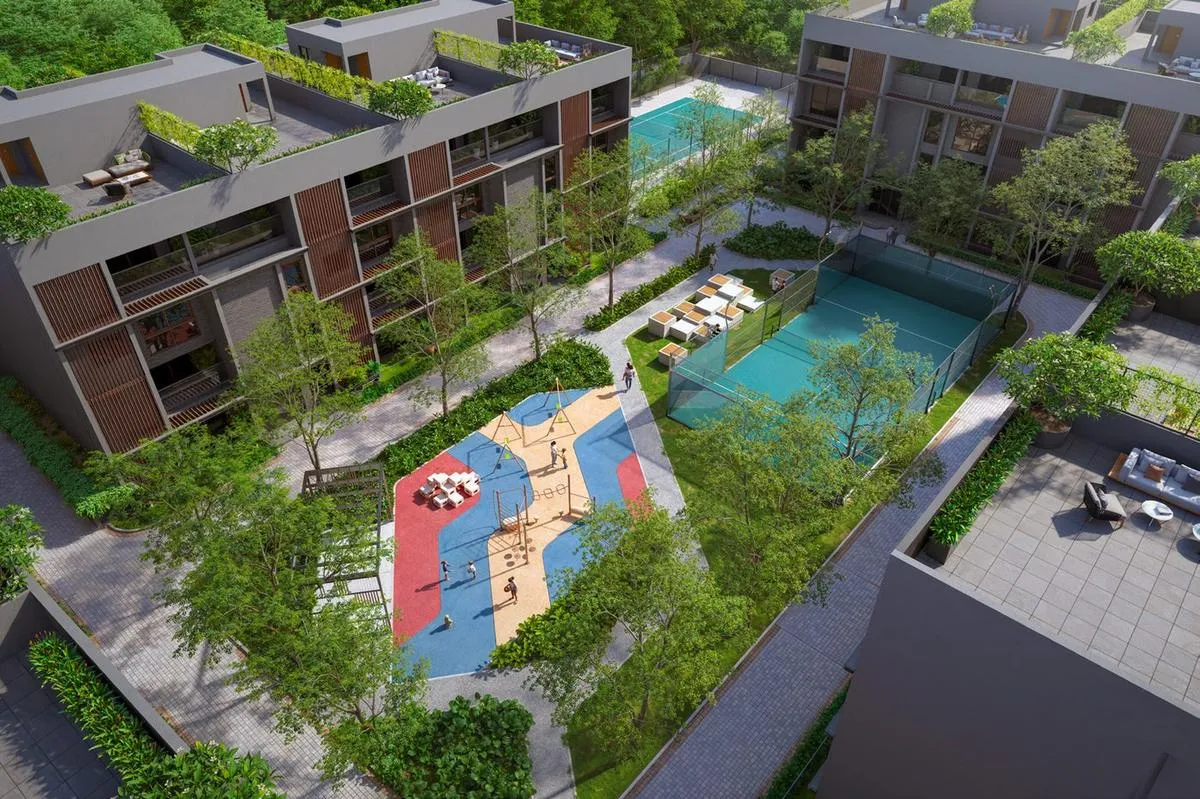
A villament is a home spread over two or more floors of its own, inside a low rise block shared with only a few other homes. The word joins "villa" and "apartment": you get villa style space, your own entrance and a private garden or terrace, while the land, security and clubhouse are shared as they are in an apartment complex.
That is the villament meaning in one line. Below is what it means in practice, how a villament differs from a villa and from a flat, and whether it is a sensible buy. We use Assetz Mizu & Ki off Hennur Road as the example, because its numbers are published and concrete.
Villa vs villament vs apartment at a glance
| Villa | Villament | Apartment | |
|---|---|---|---|
| Land | Often a plot with its own boundaries; in group housing villas, a share of common land instead | No plot of your own; land is held in common with all owners | No plot of your own; land is held in common with all owners |
| Undivided share (UDS) | None if you own a plot outright | Yes, usually larger than a flat's, as fewer homes share each acre | Yes, usually the smallest share |
| Floors | A whole house, often two or three levels | Several levels of your own inside a low rise block | One floor of a tower, reached by lift |
| Outdoor space | Own garden, often terraces too | Private garden at ground level or a terrace higher up | Balconies |
| Neighbours | Houses on either side | A handful per block (four at Mizu & Ki) | Many per tower |
| Maintenance | Most upkeep of the house is yours | Association runs grounds and shared structure; you look after your garden or terrace | Association runs almost everything |
| Carpet efficiency | Rarely quoted this way | About 80% at Mizu & Ki | Around 75% in a typical Bengaluru tower |
| Typical buyer | Wants land and freedom to change the house | Wants house style space without running a plot | Wants the lowest entry price and one level living |
These are the usual patterns. Names vary between projects, so the sale agreement, not the brochure, tells you which structure you are buying.
Villament meaning: the short version
- Your own floors. Living, dining and kitchen on one level, bedrooms on another, sometimes a basement below.
- Your own outdoor space. A garden at ground level or a terrace higher up.
- Few neighbours. A handful of homes per block, not dozens per floor.
- Shared facilities. A common clubhouse, security and landscaped grounds run by the residents' association.
What a villament looks like at Mizu & Ki
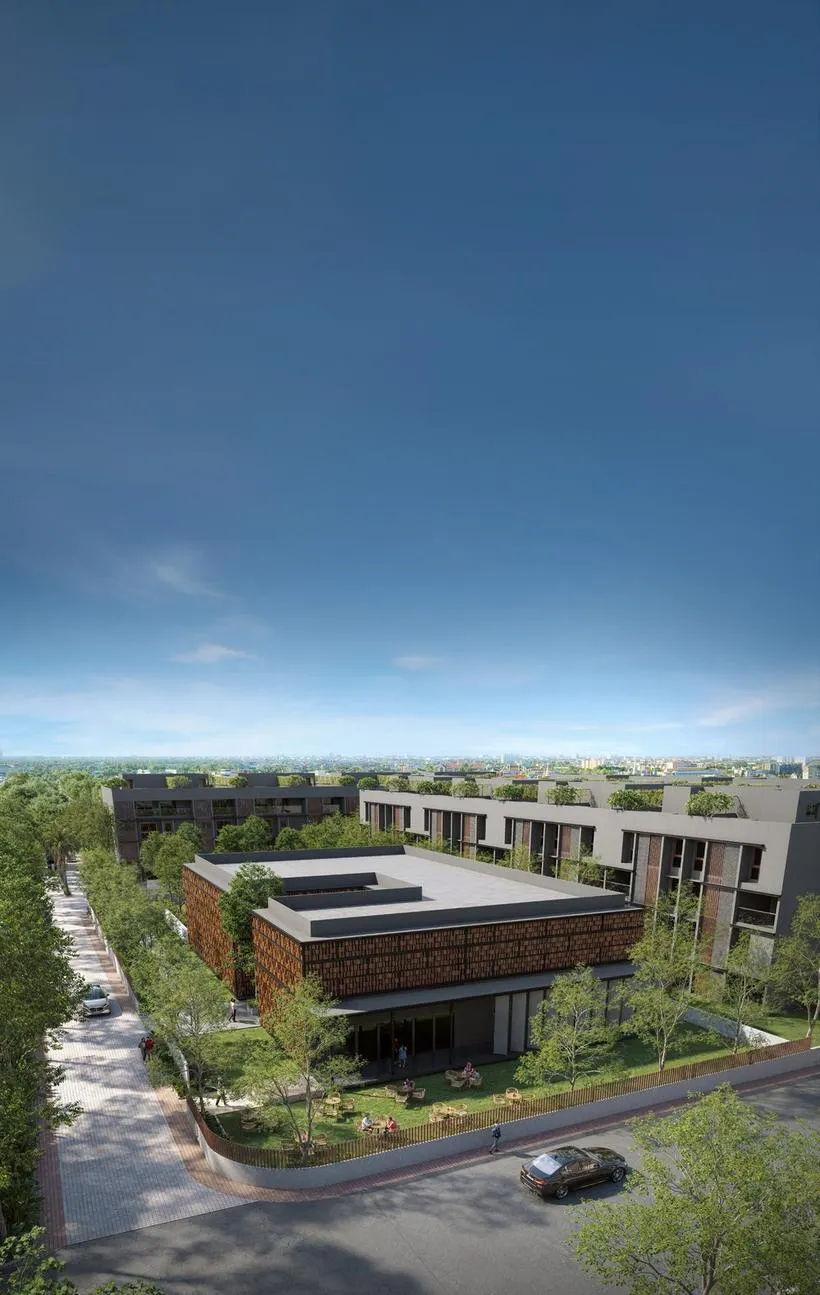
Mizu & Ki is 188 villaments on about 8 acres, built G + 4, with four homes to each cluster. Every home is a 4 BHK.
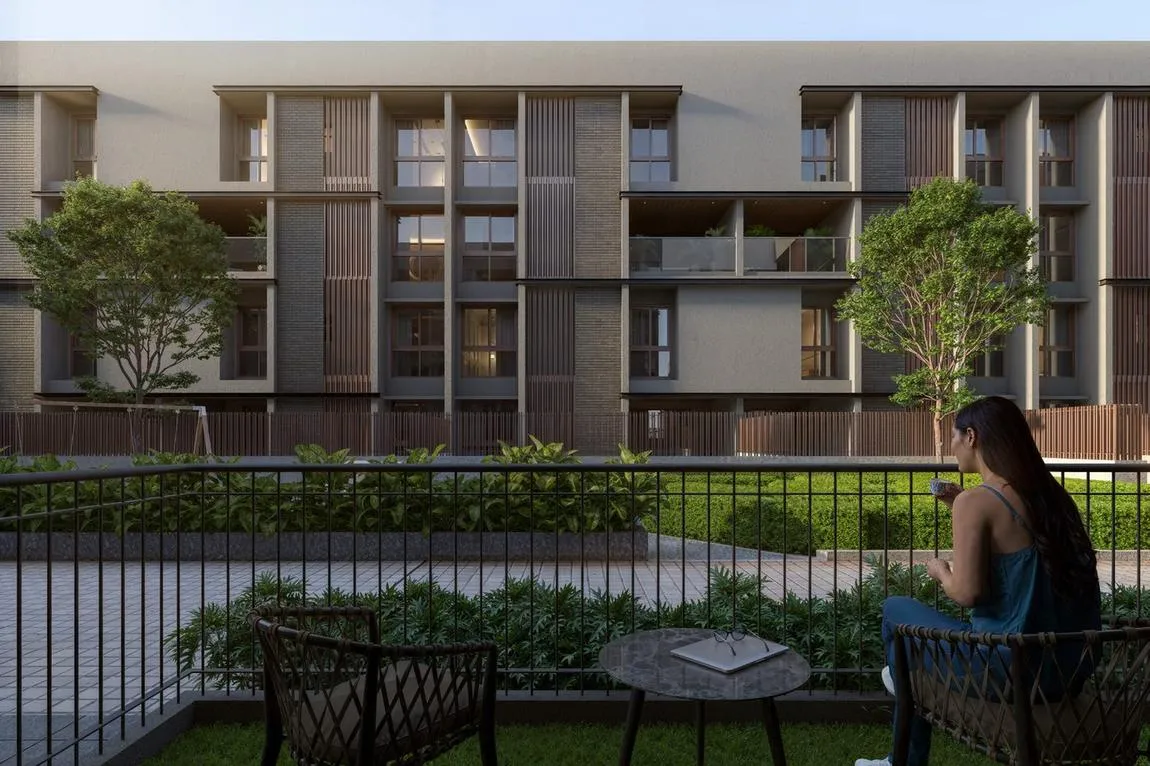
The Type 01 Garden home (3,070 sq ft super built up) is the clearest example of the format. It runs from a basement, which holds the domestic help's room, up through the ground floor to the second floor. The ground floor carries the living room (16'4" × 18'3"), dining (11'10" × 14'9"), kitchen, a bar counter and a sit out that opens onto a private use garden of about 568 sq ft. The four bedrooms and a family room sit above.
The Type 02 Open Terrace home (3,538 sq ft) swaps the garden for a private terrace behind privacy screens. Our guide to the Type 01 and Type 02 layouts goes room by room.
Villament vs villa: what is the difference?
The difference between a villa and a villament comes down to land, walls and freedom.
- Land. A villa in a plotted layout usually comes with a plot that has its own measurements and boundaries. A villament does not. You own your home plus an undivided share of the whole site, held with every other owner.
- Walls. A villa stands on its own or shares a wall with one neighbour. A villament shares walls, and sometimes floors or ceilings, with the other homes in its block.
- Freedom to change. On your own plot you can usually extend or rebuild within local rules. In a villament, changes to the outside need the association's consent, and the building cannot be rebuilt by one owner.
- Upkeep. A villa owner usually looks after the roof, walls and garden. A villament owner pays a monthly charge and the association handles the structure and grounds.
- Price. A villa usually costs the most for the same floor area, because you pay for more land. Our guide to villament price in Bangalore and what drives it works through the numbers.
Why villaments often give you more usable space
Carpet efficiency is the share of what you pay for that sits inside your own walls. A tower needs long corridors, lift lobbies and stair cores on every floor, and the cost of those is spread across every flat. A low rise block of four homes needs far less of that.
At Mizu & Ki, Type 01 has 2,463 sq ft of carpet including balcony on 3,070 sq ft built up. That is about 80%. A typical Bengaluru tower flat is around 75%. On a home of this size the gap is roughly 150 sq ft, which is close to a spare bedroom.
Is a villament a good buy?
It depends on what you want the home to do. The format has clear strengths and clear limits, and neither depends on what the market does next.
The case for. You get space close to a house: separate floors for living and sleeping, a garden or terrace, and few neighbours. Efficiency is high, so less of the price pays for corridors. The association runs the grounds and security, which suits families who travel or who live abroad part of the year.
The case against. You do not own a plot, so you cannot rebuild, and any change to the outside needs consent. A home that runs from a basement to a second floor means stairs every day; if elderly parents will live with you, ask about lift access for the specific unit. There are also far fewer villaments than flats in any one area, so there are fewer similar homes to judge a price against. And a community of 188 is quiet by design. It will not have shops or offices inside the gate.
A villament makes most sense for a family that wants house style space, can live with stairs, and would rather pay a maintenance charge than manage a plot.
What to check when a project calls itself a villament
"Villament" is a marketing word, not a category in approval documents. So look past the label.
- How many homes share each block. Mizu & Ki has four. More homes per block means the result feels closer to a flat.
- What is owned and what is for private use. The Type 01 garden is listed as a right to private use. Read exactly how the sale agreement describes your garden or terrace.
- Your undivided share of land. Ask what share of the land goes with your home, and see it written into the agreement.
- Carpet area in writing. Ask for RERA carpet, balcony and common area separately. For Type 01 those are 2,264, 199 and 607 sq ft.
- Stairs and levels. Walk the full height of a sample or a plan before you commit.
If you are weighing a villament against a tower flat at a similar budget, our hub compares the two formats directly in Mizumi Reserve vs Mizu & Ki.
 Villaments in Bangalore: six things to check before you buy
 Looking for a 4 BHK villa in North Bangalore? Compare a villament first
 Mizu & Ki amenities: an 18,000 sq ft clubhouse for 188 homes